


Pet Oral Care Finger Toothbrush Set (2-PCS)
Pet Oral Care Finger Toothbrush Set (2-PCS)

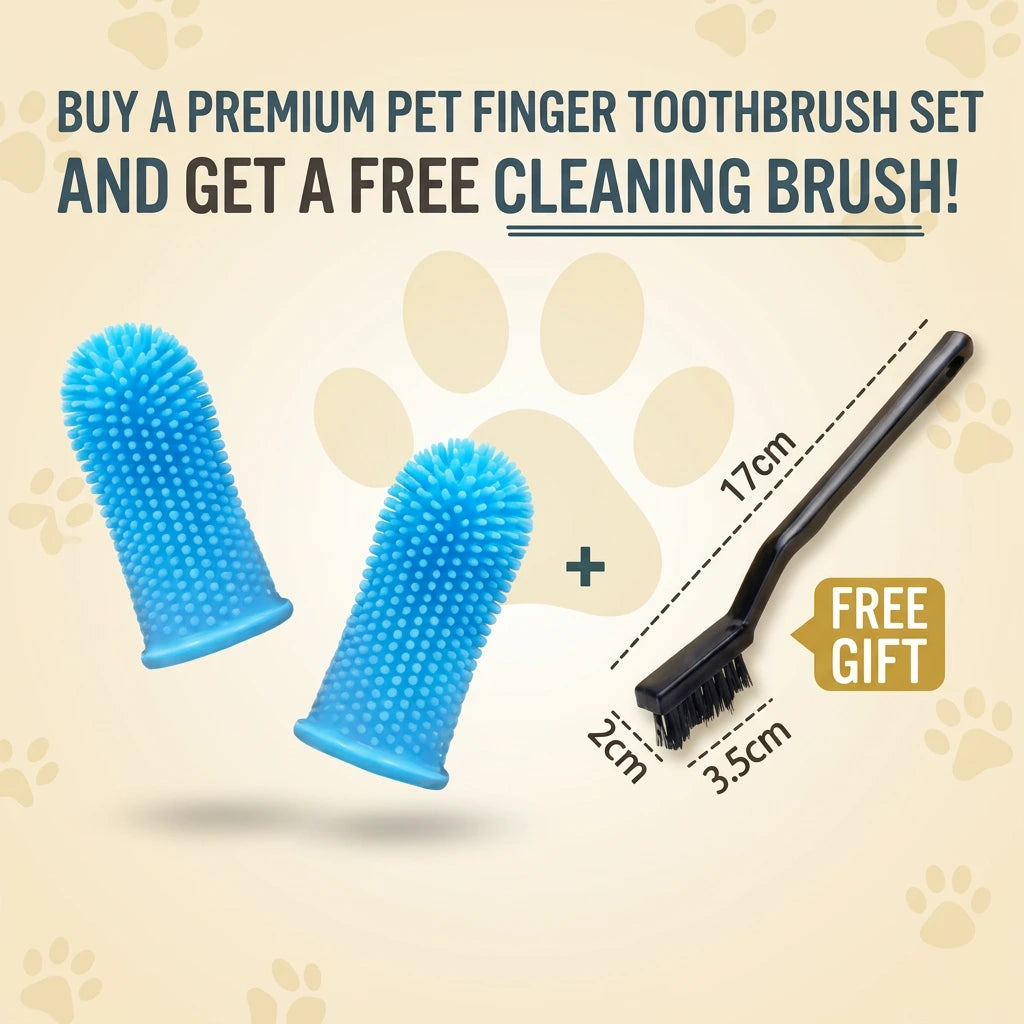
Removes plaque before it becomes a $500+ vet problem — Soft 360° micro-bristles lift food debris and bacteria off the tooth surface and along the gumline before it has a chance to harden into tartar — the same buildup behind the periodontal disease that affects up to 80% of dogs and cats by age three.
Turns brushing time into bonding time — The flexible, glove-like silicone fits snugly over your finger so your pet feels your hand, not a hard plastic tool jabbing into their mouth. That single difference is why finger brushes are the easiest entry point for nervous, food-motivated, or first-time pets.
Built for real routines, not demo videos — Gentle enough for a shaky first attempt, tough enough for daily use on the back molars where most tartar hides, and fully dishwasher-safe so cleanup never becomes the reason you skip a week.
We handcraft our Pet Oral Care Finger Toothbrush Set in limited production runs to guarantee premium, high-density materials. Next batch ships:
Couldn't load pickup availability
My pet's breath doesn't seem that bad — do I really need this?
My pet's breath doesn't seem that bad — do I really need this?
That's actually the exact moment prevention does the most good. Plaque forms silently and starts hardening into tartar within 24–72 hours of a meal, long before breath odor becomes noticeable to you. By the time the smell is obvious, bacteria has often already worked its way beneath the gumline. Veterinary data shows roughly 80% of dogs and 70% of cats already have some degree of dental disease by age three — most of it invisible from the outside. Brushing now, while things look fine, is the difference between a 60-second daily habit and an expensive anesthetic cleaning later.
My dog won't even let me near their mouth, let alone brush their teeth.
My dog won't even let me near their mouth, let alone brush their teeth.
This is precisely the problem the finger format was designed to solve. A rigid brush handle reads as a foreign object and triggers resistance in pets who are already mouth-shy. A finger brush reads as your hand — something they already trust. Start by letting your pet lick a dab of pet-safe toothpaste off the brush with zero brushing involved. Over a few days, progress to simply resting the brush against their front teeth for a few seconds before rewarding them. Most pets who flatly refuse a handled toothbrush will tolerate a finger brush within the first week because the sensation feels familiar rather than invasive.
I already give dental chews and treats — isn't that enough?
I already give dental chews and treats — isn't that enough?
Dental chews are a helpful supplement, but they only clean the surfaces your pet actually chews on — usually the molars on one side, briefly. They do almost nothing for the front teeth, the canines, or the gumline, which is exactly where the bacteria responsible for gum disease lives and multiplies. Brushing is still considered the gold standard by veterinary dental specialists because it's the only method that physically disrupts plaque across the entire mouth, not just the chewing surfaces. Pairing chews with regular brushing covers the gaps that chews alone leave wide open.
Why does this cost more than the $6 finger brush I saw at the pet store?
Why does this cost more than the $6 finger brush I saw at the pet store?
Cheap finger brushes are usually made from thin, low-density rubber that splits at the seams within weeks, traps bacteria in surface scratches, and goes stiff after a handful of dishwasher cycles — at which point it's no longer cleaning anything, it's just irritating gums. Our kit is molded from a single piece of medical-grade, BPA-free, non-porous silicone dense enough to hold its shape and bristle structure through months of daily use. You're not paying for a finger-shaped piece of rubber — you're paying for a brush that's still doing its job in month three, not falling apart in week three.
Isn't this just a gimmick — won't a regular handle toothbrush work just as well?
Isn't this just a gimmick — won't a regular handle toothbrush work just as well?
A handle toothbrush can absolutely work — for a pet who already tolerates brushing. The problem is most pets don't start there. Vets routinely recommend finger brushes as the entry point specifically because they give you more tactile feedback (you can feel resistance, sensitivity, or pain your pet can't tell you about) and they reach the back molars more comfortably in smaller mouths. Many owners who "graduate" to a handle brush only get there because a finger brush built the trust first. It's not a gimmick — it's the step that makes brushing possible at all for the pets who need it most.
I have a cat, not a dog — will this even work for them?
I have a cat, not a dog — will this even work for them?
Yes — cats are actually one of the best use cases for a finger brush. Handle brushes are often too bulky and intimidating for a cat's smaller mouth and lower brushing tolerance, while the soft, low-profile silicone finger design lets you work in short, controlled sessions that match a cat's patience level. Combined with a cat-safe poultry or seafood-flavored toothpaste, most cats accept the finger brush far more readily than any handled alternative.
My pet is already healthy. Why would I need this now?
My pet is already healthy. Why would I need this now?
That's exactly the window where prevention is easiest and cheapest. Periodontal bacteria doesn't stay contained in the mouth — left unmanaged, it can enter the bloodstream and has been linked by veterinary researchers to added strain on the heart, kidneys, and liver over time. Waiting until there's a visible problem means you're managing damage instead of preventing it, and professional dental cleanings under anesthesia typically cost several hundred dollars. A few minutes a week now is the lowest-cost insurance policy you can buy for your pet's long-term health.
What if my pet bites down on my finger while I'm brushing?
What if my pet bites down on my finger while I'm brushing?
This is a common first-time worry, and it's exactly why we recommend a slow, treat-led introduction rather than diving straight into a full brushing session. Most "bites" during early sessions are really just a pet mouthing or testing the new sensation, not aggression — and the soft silicone means there's nothing rigid or sharp involved even if they do clamp down. Keep early sessions under 15 seconds, reward generously, and let your pet set the pace. Within a week or two, most pets settle into the routine and stop reacting defensively altogether.
How long will one brush actually last, and is it worth buying more than one?
How long will one brush actually last, and is it worth buying more than one?
With regular use, the silicone bristles on a single finger brush typically stay effective for 8–12 weeks before they start to flatten and lose their plaque-lifting texture — the same lifespan you'd expect from a human toothbrush. A single kit (4 brushes) generally covers about three months of consistent brushing. Most pet parents who start with one kit end up reordering within the first season, which is exactly why the 2- and 3-kit bundles exist: lock in a lower per-brush price now instead of paying full price again in a few months.





Customer Reviews

Amazing product! Highly recommend.

Happy pet, happy fur dad!

Stopped dreading nail day. My whole household is less stressed because of this!

Worth it for my baby! Will buy again.

This is perfection. Smart, practical, worth every penny.

Outstanding service and product!
Amazing product! Highly recommend.
Happy pet, happy fur dad!
Stopped dreading nail day. My whole household is less stressed because of this!
Worth it for my baby! Will buy again.
This is perfection. Smart, practical, worth every penny.
Outstanding service and product!

You're Smelling the Warning Sign, Not Just "Dog Breath"
It's one of the most common jokes pet owners make — "ugh, dog breath" — but that smell isn't a personality quirk, it's the byproduct of bacteria actively breaking down food particles and tissue along your pet's gumline. Left alone, that bacteria doesn't stay still. It calcifies into tartar within days, pushes the gums back, and creates pockets where infection can quietly take hold for months before anything looks visibly wrong. By the time most owners notice redness, bleeding, or a tooth that looks "off," the disease process has often been running for a long time underneath the surface.
The Pet Finger Toothbrush is built to interrupt that process at the source. The 360° micro-bristle design wraps fully around your fingertip so you're not just brushing the visible front of the tooth — you're reaching the gumline and the inner surfaces where plaque actually accumulates fastest. Owners who brush consistently typically notice fresher breath and visibly cleaner teeth within the first two to three weeks, with continued improvement in gum color and sensitivity as the routine becomes a habit. It's not a fragrance fix. It's the actual mechanism that causes the smell in the first place, addressed directly.

Gum Disease Doesn't Stay in the Mouth
It's easy to think of dental health as a cosmetic issue — something that affects breath and maybe a vet bill down the line, nothing more. But periodontal bacteria doesn't respect boundaries. Once gum tissue is inflamed or broken down, that bacteria has a direct entry point into the bloodstream, where veterinary researchers have linked chronic, untreated dental disease to added strain on the heart valves, kidneys, and liver over a pet's lifetime. What starts as plaque on a molar can, over years of neglect, become a contributing factor in problems that have nothing to do with the mouth at all.
This is the part of dental care that's genuinely preventable, and it's also the part most owners skip — not out of negligence, but because a hard plastic toothbrush is hard to use on a squirming, mouth-shy pet. The finger brush format removes that barrier. Because it feels like your hand instead of a foreign tool, you're far more likely to actually keep up the routine instead of giving up after one bad attempt. A consistent few minutes a week is a fraction of the cost, stress, and risk of a dental cleaning under general anesthesia later — and it protects more than just your pet's smile.

Designed for the Mouths (and Fingers) You Love Most
A dental tool that goes inside your pet's mouth every week is not a place to cut corners. That's why we didn't use the thin, low-density rubber found in most bargain finger brushes — material that splits along the seams, traps bacteria in micro-scratches, and stiffens up after just a handful of dishwasher cycles. Every brush in this kit is molded from a single piece of medical-grade, BPA-free, non-toxic silicone, dense enough to hold its bristle structure through months of real, daily use without breaking down into something that's doing more harm than good.
The fit matters just as much as the material. Each brush is designed with enough stretch to comfortably fit a range of finger sizes, so the same kit works whether you, your partner, or your teenager is the one handling brushing duty that week. It's fully dishwasher-safe, dries quickly, and resists the odor buildup that plagues cheaper porous rubber. When you choose a kit built to last, you're not just buying a dental tool — you're removing the friction and inconsistency that cause most at-home dental routines to quietly stop after a month.
FAQ
What exactly is the Pet Finger Toothbrush Kit, and how is it different from a regular dog toothbrush?
It's a soft, glove-like silicone sleeve that slides directly over your fingertip, replacing the rigid handle-and-head design of a traditional toothbrush. The 360° micro-bristle surface wraps fully around the fingertip, so instead of angling a stiff brush head into a small, moving mouth, you get direct tactile control — you can feel resistance, sensitive spots, or problem areas your pet can't otherwise communicate. It's specifically built as the easiest entry point for pets who won't tolerate a handled brush, and the format vets most often recommend for first-time dental routines.
How often do I actually need to brush for this to make a difference?
Daily brushing produces the best results, but research on canine and feline dental health consistently shows that even 2–3 sessions per week meaningfully slows plaque accumulation compared to no brushing at all. The biggest factor isn't perfection — it's consistency. A realistic twice-a-week habit you stick to for months will outperform daily brushing that fizzles out after two weeks every time.
How soon will I actually notice a difference?
Most owners report fresher breath within the first one to two weeks of consistent brushing, as surface plaque and odor-causing bacteria are physically removed. Visible improvements in gum color, reduced tartar buildup along the gumline, and a generally healthier-looking mouth typically become noticeable over three to six weeks of regular use. Dental health is cumulative — the longer the routine continues, the more it compounds.
What toothpaste should I use with it, and can I use my own toothpaste?
Always use a toothpaste specifically formulated for pets — never human toothpaste, which often contains xylitol and other ingredients that are unsafe for dogs and cats to swallow. Pet-safe enzymatic toothpastes are designed to be swallowed without rinsing and typically come in flavors (poultry, beef, seafood) that pets actively enjoy, which makes the entire routine easier to maintain.
Is this safe to use on puppies, kittens, and senior pets?
Yes. The soft silicone bristles are gentle enough for developing puppy and kitten gums, and flexible enough not to aggravate the more sensitive, sometimes receding gums common in senior pets. For very young pets, start with the introduction phase only (no active brushing) until adult teeth are fully in. For senior pets with existing dental sensitivity, brush with lighter pressure and shorter sessions, and check with your vet if you notice any bleeding or visible discomfort.
My pet already has some tartar or mild gum redness — is brushing still okay, or will it make things worse?
For mild tartar and gum irritation, gentle regular brushing is one of the most effective things you can do, as it physically removes the plaque feeding the inflammation. For pets with more advanced tartar buildup, heavy bleeding, or visible pain, we'd recommend a veterinary dental check first — brushing is excellent for prevention and maintenance, but it isn't a substitute for treating an existing infection or removing hardened tartar that's already calcified onto the tooth.
Will silicone bristles actually remove tartar, or just polish the surface?
The micro-bristle texture is effective at lifting and disrupting soft plaque before it has the chance to harden — this is where brushing has the most impact. Once plaque has fully calcified into hard tartar, no at-home toothbrush (silicone or otherwise) can fully remove it; that requires a professional cleaning. The real value of consistent brushing is preventing that hardening from happening in the first place, which is also the cheapest and lowest-stress point in the entire process.
Can I use the same brush on multiple pets in my household?
We'd recommend a dedicated brush per pet rather than sharing one across multiple animals, since brushes can transfer bacteria between mouths. This is exactly why the kit comes with 4 brushes per pack — enough to assign one per pet in most households, or to rotate through fresh brushes for a single pet without needing to reorder right away.
How long does each brush actually last before it needs replacing?
With regular use (2–7 times per week), expect each brush to stay fully effective for roughly 8–12 weeks before the bristle texture starts to flatten and lose its plaque-lifting ability — similar to the lifespan of a human toothbrush. A single 4-pack typically covers about three months of consistent use for one pet, which is why most pet parents move up to the 2- or 3-kit bundle to avoid running out mid-routine.
Does this actually improve my pet's overall health, or is it mostly about fresh breath?
It's about far more than breath. Untreated dentalse is linked by veterinary research to inflammation that can enter the bloodstream and place added strain on the heart, kidneys, and liver over time, in addition to causing painful tooth loss and infection in the mouth itself. Fresh breath is simply the most immediately noticeable sign that the underlying bacterial load in the mouth has gone down — the real benefit is happening below the surface, supporting your pet's long-term health.
what our customers say about us
-
Hailey M.Verified Buyer"Incredible product!""This completely changed our nightly routine. My dog used to hate anything near his mouth and now he actually sits still for it. Ordering two more so I always have backups ready to go."
-
Chris D.Verified Buyer"Highly recommend for anxious pets""Our rescue used to growl at the sight of a toothbrush. This finger brush feels nonthreatening to her and we've had zero issues. The silicone is thick and holds up great in the dishwasher."
-
Natalie F.Verified Buyer"Worth every single penny""I hesitated at the price compared to the cheap pet store brushes, but the quality is night and day. It doesn't fall apart, doesn't smell, and actually does the job."
-
Greg P.Verified Buyer"Amazing for cats too!""Wasn't sure this would work on my cat but she tolerates it way better than I expected. Breath is noticeably better after a few weeks. Already ordered a second kit."
-
Sandra LVerified Buyer"No more fighting at brush time""My dog used to bolt the second he saw a toothbrush. This one he barely notices. Genuinely surprised at how much easier this made the whole process."
-
Victor N.Verified Buyer"Super soft and durable""Three months in and the bristles are just now starting to flatten, exactly when they said they would. Glad I grabbed the 3-pack upfront so I've got fresh ones ready."
-
Monica T.Verified Buyer"Perfect for senior dogs""My old girl has sensitive gums and this is gentle enough that she doesn't flinch. Vet noticed less tartar at her last visit. Will keep repurchasing."
-
Adam K.Verified Buyer"The best dental kit I've tried" ""Tried three different brushes before this one and none of them stuck. This is the first one my dog actually tolerates consistently. Buying the bundle next time."
-
Bethany R. June 2024Verified BuyerNice Product "Completely odor-free and easy to clean""Rinses clean in seconds and doesn't hold smell like the rubber one I had before. Simple, effective, does exactly what it says."
-
Ian C.Verified Buyer"Glad I bought the bundle""Started with one kit to test it out, immediately saw why people buy multiple. Bristles wear down faster than you'd think with daily use. Just ordered another 3-pack to keep on hand permanently."